Article in the Journal of Medical Humanities

My Cotton Mather article is officially published! I couldn’t afford open access, but Friday was the online publication date! I have worked on this article for four years, and am so grateful to the many people who have read drafts, provided feedback, and helped me hone and clarify my argument. Thank you, of course, to Kristina Bross for supporting this project from its inception; to Kelly Wisecup for looking at SO SO SO many drafts; to Arielle McKee and the Purdue EARG crew for giving comments; and to Reiner Smolinski and the anonymous readers and editors at EAL and the Journal of Medical Humanities. Your feedback was invariably thoughtful and constructive.

Abstract

This essay provides a literary history of the restitution narrative in colonial New England; using Cotton Mather’s The Angel of Bethesda (1724), I argue that Puritan medical texts employ theological and medical epistemologies to enable patient agency. In these texts, individuals must be involved in reforming the sinful behaviors that they believed caused their conditions, and must also engage in a form of public health by sharing their stories so that others may avoid future sins—and therefore illnesses. Ultimately, recognizing how restitution has been historically defined allows for alternate understandings of recovery that place patients at the center.


https://link.springer.com/article/10.1007/s10912-019-09583-9

As Summer Ends…

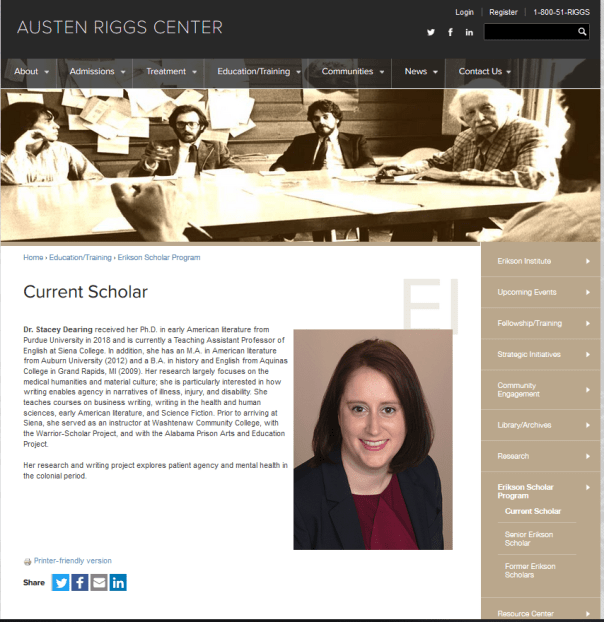
Today is my last day as the Erikson Scholar in Residence at the Austen Riggs Center. To say I will miss this place, the fabulous people I had the privilege to work with, and the cottage I called home for the last three months, would be an understatement. It’s been great to form new links across disciplines!

While in residence, I collaborated with a fantastic group of psychologists, established a grounding in psycho biography and psycho history, read more than 100 sources, and wrote 90 rough-draft pages of my manuscript.

This afternoon I’ll head home. I can’t wait to see my dogs, and more importantly, to bring what I learned at Riggs into my courses at Siena this fall! The disease and disability in early American literature class is going to be fabulous!

Public Humanities in Action!

On July 31, 2019, I gave a talk as part of the new Austen Riggs Center public lecture series on mental health. The series is an extension of the Riggs centennial, and was incorporated into their public exhibit: “The Hospital on Main Street: Human Dignity and Mental Health.”

In my talk, I gave an overview of attitudes toward mental health in the colonial period, beginning with Native American perspectives on mental illness, then covering colonial Puritans in Massachusetts, and ending with the development of secular mental health treatment in the early years of the American republic (pre-contact to about 1812).

My main argument for this research is that attitudes toward mental health have varied, but mental illnesses have always been present in America. At several points, mental illness has been viewed just like any other kind of illness. Colonial Puritans also believed they had a duty to support and care for one another for the good of society. The health of everyone mattered.

Studying the good and bad parts of the history of mental health in this country is valuable because it normalizes and de-stigmatizes mental illness. Putting all aspects of health back into our history can  help us be more empathetic, remind us to care for one another, and to see each other as people.

Graduate School Panel: Mentoring in Action

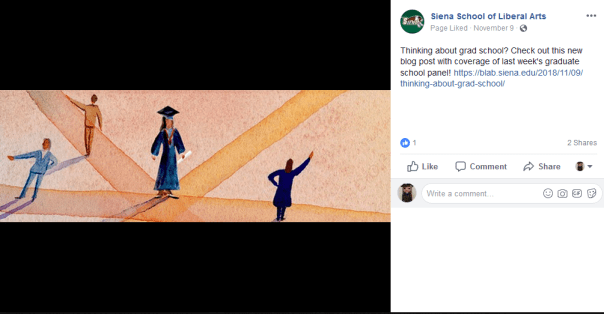
On Wednesday, November 7th, I will be joining two of my English department colleagues to talk to our students about graduate school. Together, we’ll be offering honest advice about whether or not to pursue an MA, MFA, or PhD, and giving tips on what to know prior to starting an academic career. I’m looking forward to sharing my experience and hearing what questions Siena’s students have about grad school!

Screenshot 2018-11-06 18.22.27.png

Spring 2019 Teaching Flyers

I’m super excited about the courses I will be teaching at Siena in the spring. In addition to teaching Writing 100 again (with a theme of conspiracy theories which my students are really enjoying!), I am also teaching a Short Story class focused on science fiction, and I’m putting together a brand new course on Rhetoric and Social media! Stay tuned for syllabi and assignment sheets on my teaching page (coming January 2019).

SEA Junior Scholar of the Month!

This month I was honored to be recognized as the Society of Early Americanists’ Junior Scholar of the Month. I was nominated by a scholar in the field, and provided an interview to the SEA. You can read it here: https://www.societyofearlyamericanists.org/whats-new-announcements/sea-junior-scholar-of-the-month-for-october-stacey-dearing

Working with the SEA is part of my ongoing dedication to service in the field. I am privileged to be able to work with such generous, inspirational scholars! Stacey Dearing Junior Scholar of the Month Oct 2018


Mary Prince Google Doodle!

I don’t usually get excited about Google Doodles, but yesterday they honored Mary Prince’s 230th birthday. Prince was the first black woman to publish a slave narrative in England, and was an ardent abolitionist. Here’s a quote from the Google piece that stands out:

“I have been a slave myself,” Prince wrote in The History of Mary Prince, a West Indian Slave. “I know what slaves feel—I can tell by myself what other slaves feel, and by what they have told me. The man that says slaves be quite happy in slavery—that they don’t want to be free—that man is either ignorant or a lying person. I never heard a slave say so.”

https://www.google.com/doodles/mary-princes-230th-birthday